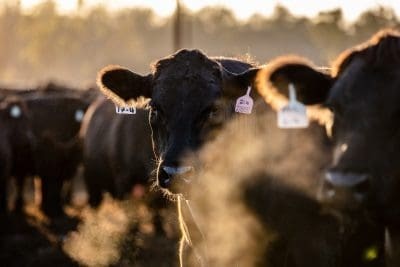
AS PART of one of the four key work areas in relation to the beef industry’s Carbon Neutral 2030 Roadmap referring to greenhouse gas emissions from livestock, it has been discovered that the current equation used to determine the levels of enteric methane emissions from feedlot cattle may overestimate the numbers.
The challenges and research findings regarding methane emissions from feedlot cattle in Australia, particularly focusing on discrepancies in the Moe & Tyrell equation developed in 1979. This equation, originally designed for North American dairy cattle, is now being questioned for its accuracy in predicting methane emissions from Australian feedlot cattle.
The research highlighted various issues:
- Accuracy Issues: The equation tends to overestimate methane emissions from Australian feedlot cattle by significant margins, as evidenced by recent studies using long-term, field-based measurements.
- Regional and Dietary Differences: The study noted that Australian feedlot conditions and diets differ substantially from those in North America, which the Moe & Tyrell equation was originally based upon. These differences contribute to inaccuracies in emission predictions.
- Implications for Industry: The inaccuracies have implications for Australia's national greenhouse gas inventory reporting under international agreements like the Paris Agreement. They also impact the feedlot industry's ability to manage and mitigate methane emissions effectively.
- Future Directions: Researchers like Professor Fran Cowley emphasize the need for updated methodologies that reflect current feedlot practices and regional realities. This includes ongoing research into more accurate prediction methods and technologies to mitigate greenhouse gas emissions.
The findings of the project provided evidence to other researchers’, including Fran Cowley, Associate Professor of Livestock Production at the University of New England, that there may be better ways to predict emissions from feedlot cattle.
Prof Cowley noted that with the Moe & Tyrell equation, there was a very different physiology in play.
“We’re also talking about an equation which is based on 50-year-old genetics, which may make it inappropriate to use the equation for dairy cows let alone for feedlot cattle – North American Dairy cow diets are also very different to that of Australian feedlot cattle.”
The future
When asked what this meant for producers and the industry, Prof Cowley said a lot of this was a future-proofing exercise – providing support to grain feeding being a method of reducing the carbon footprint of beef.
“The feedlot industry is an important way that we can work towards a carbon-neutral food production system,” she said.
“In the future, I think it’s highly likely that we will see an environment where there will be a price on market access on carbon. Being able to have a more accurate and lower estimate of the emissions and carbon footprint of feedlots is going to ease potential issues accessing markets that require no or low emission product.”
Prof Cowley reinforced the importance of producers continuing to adopt best practices, with the research reinforcing the importance of feeding more efficiently and making sure that every mouthful of feed that cattle are consuming is being turned into more beef.
“Focusing on a more energy-dense formulation is going to help contribute to a lower carbon footprint,” she said.
Source: MLA and Beef Central