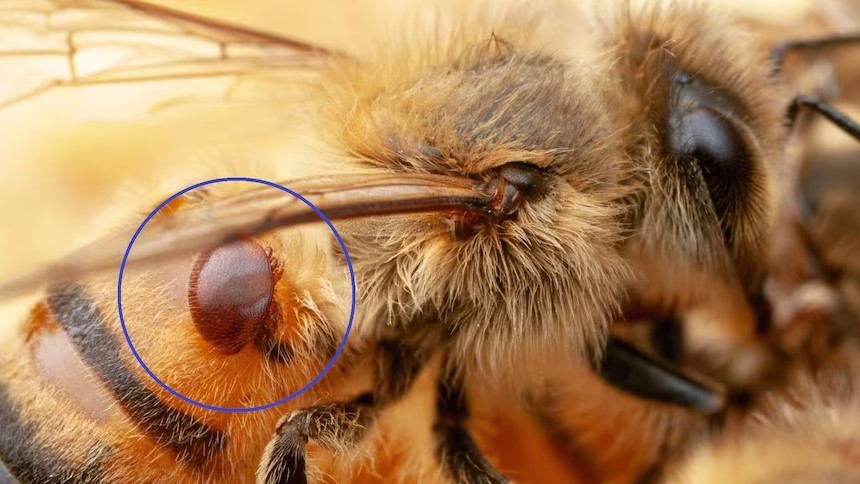
Specialist personnel will be deployed across Australia to slow the spread of the destructive varroa mite throughout the bee industry.
The federal government's National Management Group has unanimously approved a Transition to Management Plan that limits response costs to $100 million, down from a previous limit of $136 million.
The revised response plan, created by the Consultative Committee on Emergency Plant Pests, comes nearly five months after Australia abandoned efforts to eradicate the bee parasite on September 19, 2023.
According to Danny Le Feuvre, chief executive of the Australian Honey Bee Industry Council, the plan has been in the works for quite some time.
"It's been quite a big negotiation, it's got a lot of parties involved with a lot of needs and wants, and a lot of people wanting to spend as little as possible now that we were unable to eradicate as well," he said.
"It's still not a perfect plan but we were able to get agreement, which is great."
He said the 24-month plan was focused on education and extension to ensure beekeepers could understand and manage the pest.
"We want to make sure that the beekeepers are comfortable in being able to do the surveillance to find it and comfortable in what management options they need to deploy, and how can they monitor and keep continual vigil looking out for those pests," he said.
Shane Hetherington, acting chief plant protection officer for the NSW Department of Primary Industry, said it was the best plan they could come up with, but it needed time to be finalised.
"It is an extremely important piece of work in that it will provide the information and the capacity for beekeepers to move forward to manage varroa as it becomes endemic in Australia," he said.
He stated that 26 different groups, including beekeepers, almond, apple, and melon growers, and other horticultural crops that rely on pollination services, needed to reach an agreement on the next steps.
The plan will include 100 full-day workshops for beekeepers across the country, as well as 32 extension officers to assist with the education campaign.
"At the end of the day about 70 per cent of the resources that sit within the plan are devoted towards providing training and extension for beekeepers," he said.
Varroa development officers will be stationed in every jurisdiction across Australia, working one-on-one with beekeepers.
Mr Le Feuvre stated that the officers would assist them in developing their management plans, understanding the pest, and determining what treatment options would be best for their specific areas.
He stated that the officers would be especially important in states that did not yet have varroa.
"[It will] help support those beekeepers set up some industry surveillance programs where we can have a network of sentinel hives looking for that early detection, so that our beekeepers can be best prepared for when it gets to their areas," he said.
He said a pollination industry co-ordinator would also be appointed to enable the flow of information between the honey bee and pollination dependent industries.
Dr. Hetherington stated that the eradication campaign, which ultimately failed, helped to slow the spread of varroa.
"That slowing down has given us the time we need to train industries to get ready for it and made sure some of those businesses haven't gone out the door in that time," he said.
"We want to get beekeepers and pollination-dependent industries to a point where they're able to manage this serious pest with minimal government intervention."
He said the commercial availability of miticide strips had helped to slow the spread of the pest to inland NSW.
He said there were plans for the creation of a national database that would take information from beekeepers to help track the spread of varroa.
He said the voluntary monitoring system could feed its data into something that was maintained by the likes of the Australian Honey Bee Industry Council.
"We're exploring options for that as part of the plan," he said.
(Source: ABC News )