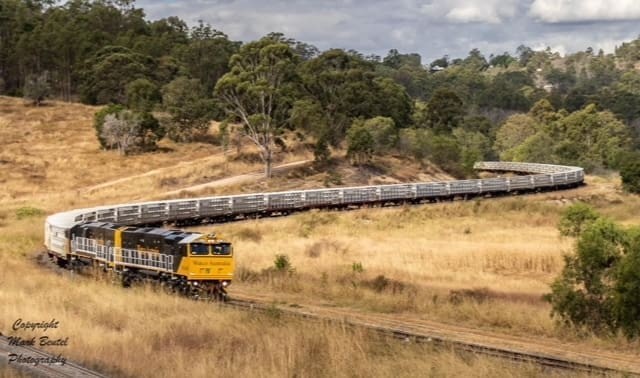
Cattle trains are once again departing from Clermont in Central Queensland one of the nation’s historically busiest rail hubs, after a quiet few years. The revival marks a significant step toward restoring rail as a viable transport option for the beef industry.
A train has already completed the journey from Clermont to Teys Australia’s Beenleigh processing plant in the state’s southeast, with additional services scheduled in the coming weeks via logistics provider Watco East West.
John Langbridge, General Manager for Industry Affairs at Teys Australia, said the company is eager to maximize use of the rail network as the national cattle herd approaches peak numbers.
“With the herd nearing its maximum size, it’s vital we utilize all available transport methods,” Langbridge said. “We see road and rail as complementary and are committed to ensuring rail continues to play its role in getting cattle to market.”
Teys has also been active on other key Queensland routes in recent years, such as Morven to Brisbane, Winton to Rockhampton, and Cloncurry to the east coast.
While the rail experience has generally been positive, Langbridge acknowledged ongoing challenges related to track maintenance and temporary closures. He emphasized the need for consistent scheduling to support producers' planning.
“Scheduled, reliable services are crucial,” he said. “Producers need certainty to align mustering and transport with rail departures, ensuring timely delivery to processing facilities.”
Teys is also working with renowned meat grading expert Rod Polkinghorne on research to assess whether rail-transported cattle can be integrated into the Meat Standards Australia (MSA) grading model. Once complete, the findings will be submitted to the MSA Pathways committee for review.
Economic Efficiency Will Decide the Future
Historically, Clermont has been a key loading point for cattle bound for both JBS Dinmore and Teys Beenleigh. However, the cattle rail network in Queensland has undergone significant changes since 2020, when Aurizon lost its transport contract to Watco East West. Since then, infrastructure upgrades have been made, and producers have regained responsibility for booking trains in some areas.
Local producers, including John Burnett from Frankfield Station, have been instrumental in reviving Clermont’s cattle rail services. Burnett noted that while road transport remains important, rail will be viable if it’s cost-effective.
“If rail proves efficient and price competitive, it will absolutely be used,” Burnett said. “Ultimately, economics will determine how cattle are moved.”
He also highlighted the broader community impact, warning that if rail services decline, the use and financial viability. of the Clermont Saleyards would also suffer.
“If we lose the train, saleyard usage drops, costs go up, and we face more pressure on our roads,” he said.
source: beefcentral.com